October 14, 2026
Cash Advance Apps That Work With Cash App (2026)
See which cash advance apps really link to Cash App, which only claim to, and each one's instant fee before you download.
Read article


The Varo cash advance app works differently from Dave or MoneyLion because Varo itself is the bank. Most apps in this category are standalone earned wage access providers that bolt onto whatever bank you already use. Varo skips that layer entirely.
That single fact changes the eligibility rules, the fee structure, and even who regulates the product.
Comparing Varo against an app like Dave or MoneyLion comes down to one tradeoff: Varo charges a flat per-advance fee with no subscription, but you have to open a full Varo Bank account and clear a deposit-history bar to get there. Here's what that looks like in practice, with the numbers Varo publishes itself.
Varo Advance is built into Varo Bank itself, which became the first American consumer fintech to receive a full-service national bank charter from the Office of the Comptroller of the Currency, granted by then-Acting Comptroller Brian Brooks on July 31, 2020, with the bank opening for business the next day.
A national charter means Varo operates under what the OCC describes as "a single, uniform regulatory framework, subject to a single primary prudential supervisor." In plain terms, Varo is supervised as a bank, and deposits sit under standard FDIC insurance protections, which cover up to $250,000 per depositor, per ownership category, the same standard that applies at any other insured bank. Standalone earned wage access apps typically don't hold deposits at all, which sets up a structurally different arrangement than a bank-based advance.
As a bank product, Varo Advance is not governed by the state EWA statutes written for non-bank providers.
You need three things, according to Varo's own cash-advance page: an active, non-suspended Varo Bank Account holding a balance of $0.00 or more (no overdraft), and either qualifying direct deposits landing directly in that account or a linked external account showing ongoing direct deposits. If you've taken an advance before, it needs to have been repaid on time, and you can't have one outstanding when you apply for the next one. Practically speaking, that means missing a due date or letting one advance run while you try to open a second is enough to pause eligibility until it's resolved.
Varo also states that qualification is subject to "evaluation of consumer reports and Varo account activity." Varo's wording stops short of promising no credit check. If an app tells you plainly it skips credit checks entirely, that's a real distinction worth comparing against Varo's more guarded wording.
As a general rule, qualifying deposits mean recurring electronic income landing in the account, such as a paycheck or a government benefit, rather than a one-off transfer. Readers should confirm the exact deposit-type rules directly with Varo before relying on any specific transaction to count, since the precise list can change.
One more eligibility note that trips people up: this is a bank product first, so you can't link an outside checking account and skip the setup. Readers who don't already have a bank account, or don't want to open a new one just to test a cash advance feature, should look at what to do if you don't have a bank account yet before committing to Varo specifically. This is worth internalizing before you start the application: standalone EWA apps typically connect to the bank you already use. Varo asks for the whole banking relationship, deposits, checking, debit card, and advance, all in one place.
Here's the number that actually answers "how much can I borrow." New borrowers start at $20 to $250, available the same day upon approval, according to Varo's cash-advance page and its help-center article on advance limits. Build a repayment history and keep qualifying deposits of $800 or more a month flowing into your account, and that ceiling can grow to $700.
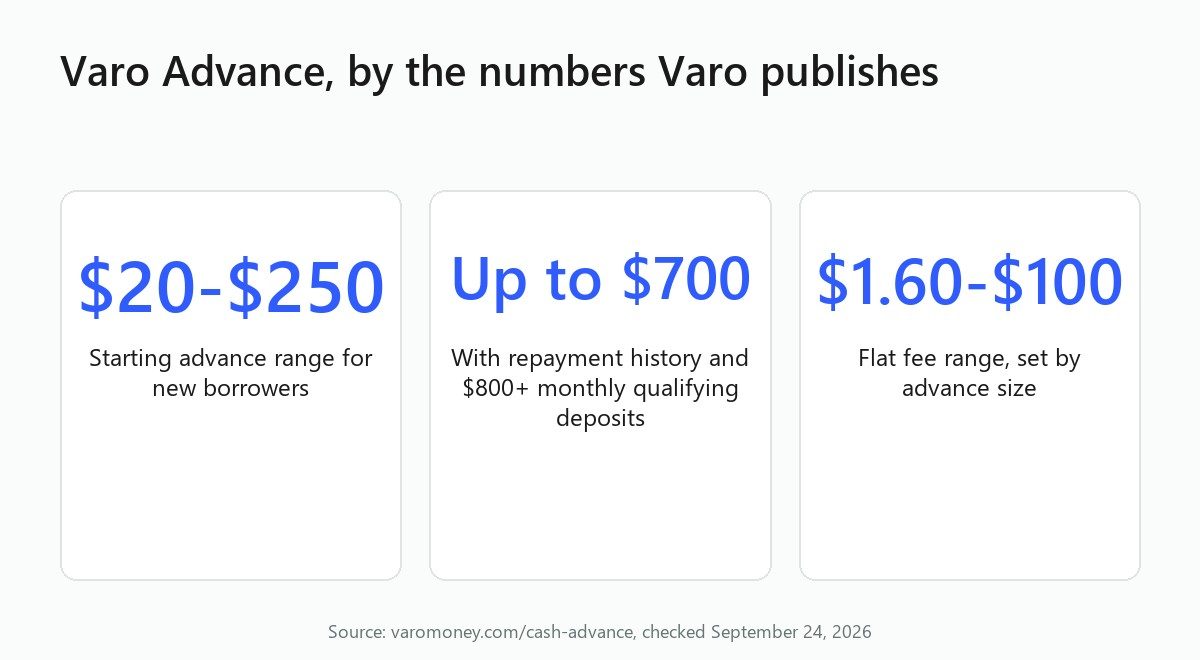
Fees are flat dollar amounts tied to how much you borrow, ranging from $1.60 up to $100, charged as a single flat amount with no subscription on top. Varo states the average advance on the platform lands around $195, an average that sits well below the $700 ceiling. Customers who keep $800 or more in qualifying monthly deposits get a reduced fee that Varo describes as "more than half" off the standard rate.
Varo also states there's no interest charged, no monthly or subscription fee, no late fee, and no penalty fee on the advance itself. If you've priced out apps that charge a recurring membership on top of an "optional" tip or express fee, this flat, one-time structure is the clearest point of contrast.
A word of caution if you've read other reviews of this product: NerdWallet's write-up cites a narrower fee range of $1.60 to $40 and a $500 ceiling. That conflicts with what Varo's own current page states, and it looks like NerdWallet is describing an older tier structure. Varo has since raised its ceiling to $700 and its top fee to $100. Treat any source citing a $500 cap as outdated information, superseded by Varo's current figures.
Other reviews of this product cover the basic fee and limit numbers but skip the OCC charter angle entirely, which is the detail that explains why Varo's eligibility rules and account structure look different from a standalone EWA app's in the first place.
Varo gives borrowers, in its own words, "a full 30 days to pay us back." Repayment is automatic: Varo debits your linked Varo Advance Account, and you can set that auto-payment date anywhere from 15 to 30 days after you receive the advance. There's no manual repayment step to remember, and, per Varo's fee disclosures, no late fee.
This payment-date flexibility is worth building into your own math. If payday lands 22 days out, you can set the debit for that date. It's a small feature, but it's the difference between an advance that lines up with your paycheck and one that debits your account before you're ready for it. Setting the auto-debit date close to your actual payday, rather than the earliest option Varo offers, is the simplest way to avoid an overdraft on repayment day.
The structural gap between Varo Advance and something like Dave or Empower comes down to what kind of company you're dealing with. A standalone EWA app is a third-party service layered on top of whichever bank you already use, operating under state-level EWA statutes that a handful of states, including Missouri, Connecticut, and South Carolina, have written for non-bank providers. Varo Advance is a feature of a chartered, FDIC-insured national bank, supervised by the OCC. As a bank product, it is not governed by those state EWA statutes.
In practice, that means you're managing one relationship instead of two: your paycheck, your checking account, and your advance all live inside Varo. Compare that to an EWA app that requires linking an external bank account it doesn't control, where a hiccup in that link can delay your advance. It also means Varo issues its own debit card tied to the account, which puts it closer to apps that give you a physical card for ATM withdrawals than to EWA apps that only push money into an account you manage elsewhere. For a reader who already banks somewhere they're happy with, that consolidation cuts both ways: it simplifies the advance process itself, but it means moving your paycheck deposits, bill pay, and daily spending to a new bank just to get access to short-term cash.
The tradeoff is flexibility. An EWA app doesn't ask you to move your whole banking relationship to use it. Varo does. If you're not ready to make Varo your primary bank, that's a real cost to weigh against the flat, subscription-free fee.
On Apple's App Store, the "Varo Bank: Online Banking" app holds 4.9 out of 5 stars from roughly 234,000 ratings, per Apple's own listing. That's the overall banking-app score, since Varo doesn't publish a separate rating for the advance feature alone.
Trustpilot tells a more mixed story. Varo's Trustpilot company page shows 4.0 out of 5 from 5,754 reviews. Trustpilot reviews cluster around two themes.
The first is sudden account restrictions or reduced deposit limits, often tied to fraud-review holds, which several reviewers connect to losing access to features like the advance mid-cycle. That pattern matters specifically for advance users: an account flagged for review can lose access to the linked Varo Advance Account mid-cycle, a different kind of risk than a standalone EWA app carries, since that app isn't tied to your core banking relationship. A reader who values a stable, uninterrupted advance feature may weigh that risk differently than one who mainly cares about cost.
The second is customer-service friction: long waits and difficulty reaching a live representative, especially when an account hold is already in progress. On the positive side, reviewers who used the advance as intended, meaning a small, short-term amount repaid on schedule, describe it as straightforward with no surprise fees, which lines up with what Varo's own fee disclosures state. Some reviewers describe Varo as useful for building a small emergency cushion between paychecks.
This split deserves attention. The advance feature itself draws few complaints when it works as designed. The complaints cluster around account holds and support access, a banking-relationship risk more than a cash-advance-specific one. Since Varo Advance lives inside your entire banking relationship, a hold on your account can knock out the advance too, in a way that wouldn't happen if the advance were a separate app layered on top of a bank you keep using normally.
The Varo instant cash advance app makes the most sense for someone who's willing to move their primary banking relationship to Varo and wants a flat, one-time fee instead of a recurring subscription. If you build a repayment history and can meet the $800-a-month qualifying deposit bar, the reduced fee tier and the $700 ceiling put real room to work with. Fall short of that $800 deposit bar and you can still qualify for an advance, just at the standard flat-fee rate rather than Varo's reduced tier.
Gig workers and anyone with irregular income can also qualify, provided that income arrives as a qualifying direct deposit. Readers with irregular income should also compare the cash advance apps built for irregular gig income already reviewed on this site.
Skip it if you're not ready to open a new bank account just to access an advance, or if you need funds before you've built any deposit history with Varo. New borrowers are capped at $20 to $250, well short of the $700 tier, and that starting range is worth planning around if the reason you're looking at an advance app is a bill closer to $500 or $700. It's also not the best fit for someone who wants a fast advance from their existing bank without a credit check; Varo's language around evaluating "consumer reports and account activity" is more guarded than that, and it doesn't rule a credit-report check out the way some competing apps do. Readers who want to compare no-credit-check angles directly should look at apps that skip a hard credit check entirely.
The Varo bank cash advance app is a feature built into a chartered national bank rather than offered as a standalone app. Varo Bank, N.A. received its full-service national bank charter from the OCC in 2020, and Varo Advance is built into that bank account rather than offered as a separate third-party product.
New borrowers can access $20 to $250, and that limit can grow up to $700 once you've built a repayment history and maintain qualifying deposits of $800 or more a month, according to Varo's own cash-advance page.
Fees are flat dollar amounts based on the size of the advance, ranging from $1.60 to $100, with no interest, no monthly subscription, no late fee, and no penalty fee on the advance itself, per Varo's disclosures.
Varo gives borrowers a full 30 days to repay. Repayment is automatic: Varo debits the linked Varo Advance Account on a date you set anywhere from 15 to 30 days after receiving the advance, so there is no manual repayment step to remember and, per Varo's fee disclosures, no late fee.
Varo states that qualification involves an evaluation of consumer reports and account activity, so it isn't accurate to call it a no-credit-check product, even though it doesn't work like a traditional hard-pull loan application either.
Varo Advance is a product of a chartered, FDIC-insured national bank, while apps like Dave are third-party EWA providers layered on top of whatever bank you already use. As a bank product, Varo Advance is not governed by the state EWA statutes written for non-bank providers.

See which cash advance apps really link to Cash App, which only claim to, and each one's instant fee before you download.
Read article
An independent Klover cash advance app review: real advance limits, express fees, the Klover+ subscription, and what it costs to use.
Read article
Chime's own SpotMe and MyPay fees and limits, plus which cash advance apps confirm Chime support on their own help pages.
Read articleSee how the top earned wage access apps stack up on fees, limits, and speed. View the full ranking