August 25, 2026
Emergency Cash Advance App: Fastest Options & Cost
Bill due this week? Compare the fastest emergency cash advance apps, real instant-transfer fees, and cheaper options to try first.
Read article


The last week before payday is the longest week of the month. The big deposit is a distant memory, the account is running on fumes, and you are doing that thing where you check the balance and then check it again five minutes later as if it might have changed. If that is where you are right now, mid-crunch and a little stressed, this is for you. No lecture about lattes. Just moves you can make today to make your paycheck last.
And before we go further: running short at the end of the cycle is common. In the Federal Reserve's 2024 survey, only 63% of adults said they could cover a $400 emergency with cash, down from 68% in 2021. So roughly one in three could not. This is a timing problem, not proof that you are failing.
It is not random that the squeeze hits at the same point every cycle. Your fixed bills, rent and utilities and the like, tend to cluster near the start of the pay period, right after the money lands. They take their cut first. What is left has to stretch across everything variable, mostly food and gas, all the way to the next deposit. So the flexible spending gets crushed into the back half of the month, which is exactly when the tank is lowest.
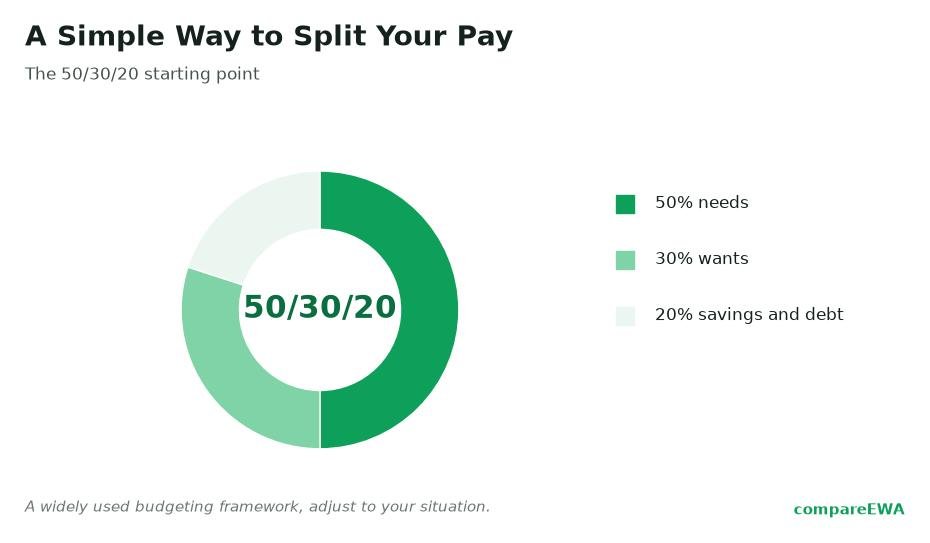
The categories doing the crushing are big ones. The Bureau of Labor Statistics tracks what households actually spend, and in 2023 housing took the largest share of the budget at 32.9%, transportation was next at 17.0%, and food came in at 12.9%. That is about 63% of spending going to just three needs. When those three eat most of your income up front, the last week is always going to feel tight. It is math, not misbehavior.
You cannot fix a shortfall you cannot see coming. So the first move is to lay your bills against your paydays on a calendar, so the crunch shows up before it hits you.
Once you can see that, for example, rent hits four days before your paycheck, you can plan for it instead of getting ambushed. Most of the panic in the last week comes from surprise, and this one exercise removes the surprise.
When money is tight, there is a strong temptation to cancel a $3 subscription and feel like you did something. Do it if you want, but understand that the real savings live in the big categories. A small percentage trimmed from housing, transportation, or food beats zeroing out a cheap streaming service every time.
Here is what that looks like in practice. On the BLS averages, households spent roughly $2,189 a month on housing and about $1,110 a month on transportation in 2023. Shaving even 5% off transportation (carpooling a couple of days, combining trips, skipping one tank) is worth about $55. You would have to cancel a lot of tiny subscriptions to match that. Attack the levers in proportion to their size. That is where the breathing room actually comes from.
In that final stretch, groceries beat takeout by a wide margin, and the single highest-impact move is cooking from what you already own. You have paid for the food in your pantry and freezer. Eating it is free in the sense that matters this week.
Try this quick reset:
Vague advice like "spend less on food" never helped anyone. Cooking three dinners from what is already in your freezer is a real, do-today action with a real dollar payoff.
Sometimes the fix is not spending less, it is shifting when a bill hits. Billers are often more flexible than people assume, and asking costs nothing but a phone call.
Some months you do everything right and the numbers still come up short. When that happens, reach for the cheapest option first and work down only as needed.
The order matters. Reaching for the expensive option first is how a tight week turns into a tight month.
Let me run one full month so this is not just theory. Say your take-home is $3,000 a month, paid in two checks of $1,500. Your fixed bills look like this: rent $1,150, utilities $180, phone $60, car insurance $130, a car payment $300. That is $1,820 in fixed costs, and most of it drafts in the first half of the month.
After the first paycheck covers rent and the early bills, you are left thin heading into weeks three and four with maybe $600 to cover groceries, gas, and anything else until the next deposit. Here is the reset in action:
That is about $150 recovered from three small moves, plus a bill shifted off the danger zone. It will not make you rich. But it can be the difference between coasting to payday and paying a $35 overdraft. Do this for a couple of months and the last week stops being an emergency.
Getting through this week is the goal today. Making next week's version easier is the goal for later. The way you do that is by shrinking the recurring gap, not just surviving it. Every due date you move, every fixed bill you lower, every small amount you tuck into a starter cushion makes the following month a little less tight. One survey of workers found that 77% would face financial difficulty if their paycheck were delayed by just one week, which tells you how thin most people's buffers are. A few hundred dollars set aside quietly changes that for you. Not this week, but soon, and permanently.
Cover the essentials that keep your life running: food, utilities, housing, and transportation to work. Pay those before anything discretionary. If you cannot cover a non-essential bill on time, call that biller and ask for an extension or a due-date change rather than skipping a payment silently.
Cook from what you already have first. Take stock of your pantry and freezer, build meals around those items, and make a short, specific list of only what you need to complete them. Skip delivery apps during the tight stretch, since a single takeout order can equal several days of home-cooked meals.
Often, yes. Many utilities, phone carriers, and lenders will move your due date for free so it falls just after payday. Call customer service and ask directly. Shifting even one or two bills out of the last week before payday can end the recurring end-of-cycle crunch.
Not for a one-time gap, as long as you use it carefully: take the free transfer, set tips to $0, and remember the advance shrinks your next paycheck. It only becomes a problem if you need one every pay period, because then it moves the shortfall forward instead of closing it. Treat it as a bridge, paired with cutting the recurring gap.
There is no perfect number, but government spending data shows households spend around 63% of their budgets on housing, transportation, and food combined. If your fixed bills are eating so much that nothing is left for the last week, that is a sign to target the big categories (housing, transportation, food) for savings rather than trimming small subscriptions.
Because your fixed bills cluster near the start of the pay cycle and take their cut first, leaving variable spending like food and gas squeezed into the back half when your balance is lowest. It is a timing pattern, not a spending failure. Mapping your bills against your paydays on a calendar lets you see and plan for the crunch before it hits.

Bill due this week? Compare the fastest emergency cash advance apps, real instant-transfer fees, and cheaper options to try first.
Read article
Need quick cash now? Six ways to get 200 dollars today, ranked cheapest first, from 0 dollars to 60 dollars over 30 days, with the math shown.
Read article
A practical plan to treat cash advance apps as a bridge, not a habit, and shrink the advance you need each payday to zero.
Read articleSee how the top earned wage access apps stack up on fees, limits, and speed. View the full ranking