August 25, 2026
Emergency Cash Advance App: Fastest Options & Cost
Bill due this week? Compare the fastest emergency cash advance apps, real instant-transfer fees, and cheaper options to try first.
Read article

There is nothing left between checks. The bills get paid, more or less, but you end each cycle at or near zero, so the second anything goes wrong (a car repair, a surprise co-pay, one bad week) you are back to scrambling. If that describes your life, I want to be clear about something right away: this is a timing and math problem, not a sign that you are bad with money. And it is fixable, even on a tight income, with a plan built for a budget that has almost no slack.
The goal is not to become a different person overnight. It is to get a little bit ahead of your bills, in small mechanical steps that survive a lean month. Let me show you how.
Living paycheck to paycheck means there is little or no gap between what comes in and what has to go out. When money in equals money out, you have no buffer, so any timing shock forces you to borrow from the next check to cover this one. That is the trap. This month's shortfall gets funded by next month's paycheck, which then leaves next month short, and around it goes.
Notice what that is not. It is not you blowing your paycheck on nonsense. For most people stuck here, the felt problem is timing: the bills do not line up neatly with a two-week pay cycle, and one thing going wrong wipes out the tiny margin. Reframing it this way matters, because you cannot willpower your way out of a structural gap. You have to build a structure that closes it.
You have probably seen scary headlines claiming most Americans live paycheck to paycheck. The honest answer is that it depends entirely on how you define the term. Bank of America Institute used a strict measure in 2025 (households spending 95% or more of their income on necessities) and found nearly 24% of households met it. Survey-based numbers run much higher: PNC reported 67% in 2025, up from 63% the year before, and other surveys land around 57% and up.
Which number is right? All and none, really. Fact-checkers at Econofact have pointed out that the phrase is loosely defined and the surveys are not measuring the same thing, so there is no single true national figure. What is not in dispute is the underlying reality: the Federal Reserve found only 63% of adults could cover a $400 emergency with cash in 2024, meaning about one in three could not. Whatever label you put on it, a whole lot of people are living without a cushion. You are in ordinary company.
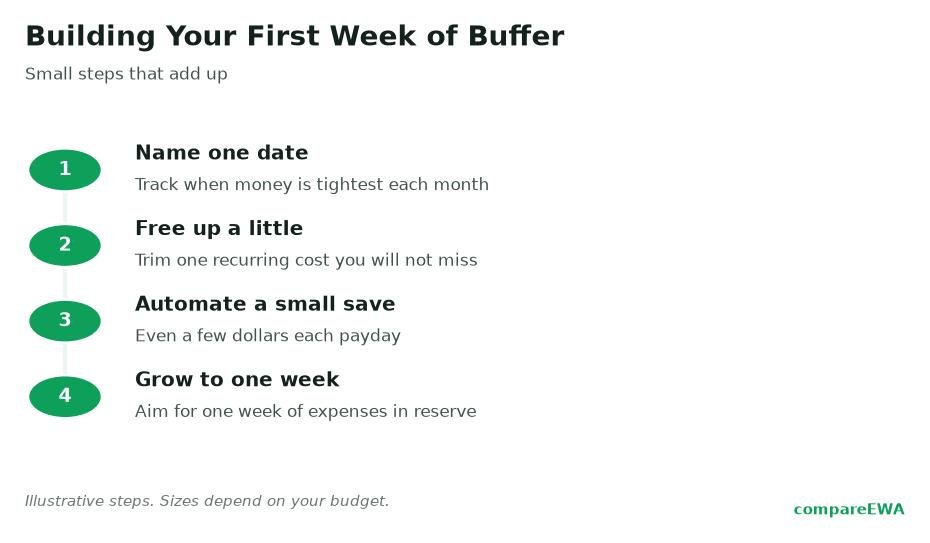
Here is the mindset shift that makes this doable. You are not trying to build a fat emergency fund right now. You are trying to build a buffer: enough to get a few days, then a week, then eventually one full paycheck ahead of your bills. That is what ends the scramble. When the money you spend this week is money you earned two weeks ago, a late bill or a shifted due date stops being a crisis.
There is a concrete benchmark worth knowing. The JPMorgan Chase Institute studied income and spending swings and found a median-income family needed about $4,800 in liquid savings to weather 90% of their ups and downs, yet typically held only about $3,000, a shortfall of roughly $1,800. For a tight-income household, scale that down. The point is not the exact dollar figure. The point is that a buffer is a specific, reachable target, and getting even partway there sharply reduces how often you get knocked back to zero.
You cannot build a buffer until you know the gap you are working with. So start here, with a simple subtraction.
If the number is small, that is fine, it is honest, and it tells you what you are working with. Even $15 or $25 a week is a legitimate place to begin. If the number is negative, that is important information too: it means the fix has to include lowering a bill (Step 4), because you cannot save money you do not have.
Willpower is a terrible savings plan on a tight budget, because at the end of a hard week there is never anything left to sweep into savings. So take willpower out of it. Make the buffer automatic and keep it out of sight.
Tight income is rarely steady income. Hours change, a shift gets added, a slow week happens, even at a stable job. That unevenness is exactly why a flat "save $50 every week" plan tends to break. So build the plan around the swings instead of pretending they do not exist.
The move is simple: save a fixed small amount every check no matter what, and add a little extra in the fat weeks. When you pick up an overtime shift or a bigger commission lands, send a slice of that surplus straight to the buffer before it evaporates into everyday spending. The good weeks are where the buffer actually grows. Protecting them is more effective than squeezing the lean ones.
A one-time cut saves you once. A lowered fixed bill saves you the same amount every single month, which compounds far faster. So this is where I would spend real effort.
Go after the recurring drains: call and ask for a better rate on your phone or internet plan, shop your car insurance, cancel a subscription you forgot you had, or ask a lender about a lower payment. Each dollar you carve off a monthly bill is a dollar that lands in your margin every month from now on, feeding the buffer without you doing anything else. If your "real number" from Step 1 was negative, this step is not optional. It is how you create the room to save at all.
While you are building the buffer, you may still hit a gap, and an earned wage access advance can bridge it. Used once in a while, as a bridge, that is reasonable. The danger is leaning on advances every cycle, because an advance shrinks your next paycheck, which reopens the same gap, which is the exact loop the buffer is meant to end. If you use one, take the free transfer, skip the tip, and treat it as a short-term patch while the buffer does the real work. The buffer is the thing that eventually makes advances unnecessary.
Let me make the ladder concrete. Say your take-home is $2,600 a month and your essentials run $2,450, leaving a real margin of $150. Thin, but not zero.
Somewhere around the $400 to $500 mark, something shifts. A surprise co-pay or a small car repair stops meaning a scramble or an advance, because the buffer absorbs it. Keep going and you build toward a full paycheck ahead, which is where the cycle truly breaks. None of these are big moves. They are $20 transfers and one phone call, stacked over time.
You do not need a full emergency fund to start feeling relief. The first meaningful target is a buffer of a few hundred dollars, enough to absorb a common surprise like a car repair or co-pay. The longer goal is to get one full paycheck ahead of your bills. Research suggests a median household needs around $4,800 to weather most income swings, but on a tight income, scale that down and focus on the milestones.
Stop trying to save what is left over, because on a tight budget there is never anything left. Instead, automate a small transfer on payday before you spend, even $10 or $20 per check, and move it to a separate account. If your essentials already exceed your income, pair this with lowering a fixed bill so you create the room to save at all.
It means the money you spend this month is money you earned last month, so your bills are covered by income you already have rather than the paycheck that has not arrived yet. That gap is what protects you from timing shocks. You build toward it in stages: a few days ahead, then a week, then eventually a full paycheck ahead.
Save a small fixed amount every check no matter what, then add extra in the higher-earning weeks. When you pick up overtime or a bigger check lands, send a portion straight to your buffer before it gets absorbed into everyday spending. Building the plan around the fat weeks handles the uneven income far better than a rigid weekly amount that breaks during a slow stretch.
They can, if you use one every pay period, because an advance reduces your next paycheck and reopens the same gap. Used occasionally as a short-term bridge while you build a buffer, an advance is reasonable. The buffer is what actually ends the reliance, so treat advances as a temporary patch, not the plan.
Start with a recurring bill that is easy to renegotiate or shop around, like phone, internet, or car insurance, since a lower rate saves you the same amount every month with no ongoing effort. Prioritize the ones you can change with a single phone call. Each dollar you cut from a fixed bill feeds your buffer month after month, which compounds faster than a one-time cut.

Bill due this week? Compare the fastest emergency cash advance apps, real instant-transfer fees, and cheaper options to try first.
Read article
Need quick cash now? Six ways to get 200 dollars today, ranked cheapest first, from 0 dollars to 60 dollars over 30 days, with the math shown.
Read article
A practical plan to treat cash advance apps as a bridge, not a habit, and shrink the advance you need each payday to zero.
Read articleSee how the top earned wage access apps stack up on fees, limits, and speed. View the full ranking