October 22, 2026
Louisiana Earned Wage Access Law: The Rules Now
Louisiana's EWA Act (La. R.S. 9:3591) took effect August 2025. No licensing, no fee cap, disclosure and no-cost rules apply instead.
Read article


If you live in Utah and use an app to pull money from your paycheck before payday, there's now a state law with your name on it. Utah's earned wage access law, the Earned Wage Access Services Act, took effect May 7, 2025, and it's codified as Utah Code Title 13, Chapter 78 (Utah Code 13-78-106). The underlying bill, H.B. 279, created this framework during Utah's 2025 General Session.
The Division of Consumer Protection, part of the Utah Department of Commerce, is the agency in charge. The statute itself says so: "'Division' means the Division of Consumer Protection created in Section 13-2-1" (Utah Code 13-78-101). That's a distinction worth holding onto, because it's not the Department of Financial Institutions. Utah chose to regulate EWA as a consumer-protection matter rather than a banking one, and that choice shapes what a provider has to disclose, what it can't do to collect, and how a complaint gets handled.
One more date matters here. Providers already operating in Utah when the law took effect had until October 6, 2025 to apply for registration (Utah Code 13-78-102(4)). That grace window has closed. As of September 2026, a provider is required to have registered, or to have applied by the October 6, 2025 deadline, to lawfully continue serving Utah customers.
Under the Act, a person may not act as a provider in Utah without registering with the Division first (Utah Code 13-78-102(1)). Registration is annual and must be renewed to stay active. And it comes with teeth: a provider's principals have to submit fingerprints and consent to a criminal background check, run through the FBI, Utah's Bureau of Criminal Identification, or an equivalent agency in another state (Utah Code 13-78-102(5)).
The statute leaves the exact registration fee to the Division's rulemaking rather than fixing a number in the code itself (Utah Code 13-78-102(2)(b)(i)). That means the fee amount can change without a legislative vote, and the code itself won't tell you the current figure.
If you want to know whether the app on your phone is actually registered, start with the Division of Consumer Protection's own earned wage access page. That's also where you'd file a complaint if something goes wrong.
Not every wage-advance arrangement falls under this law, though. Employers who advance wages directly to their own employees, payroll providers that verify hours without funding the advance themselves, and entities already regulated under Utah's Financial Institutions Act are explicitly excluded from the definition of "provider" (Utah Code 13-78-101(5)(b)). If your employer runs its own on-demand-pay benefit rather than routing you through a third-party app, that benefit sits outside Chapter 78 entirely. Your protections there, if any, come from your employer's own policy or a different body of law.
Utah's law builds its consumer protections around disclosure rather than a price cap. Before you ever agree to use a provider's service, the provider must clearly and conspicuously tell you your rights, every fee involved, and any tip or gratuity option on the table (Utah Code 13-78-103(2)(b)).
That first disclosure covers the relationship in general. A second, more specific one kicks in every time you actually request funds. At that moment, the provider has to show you the anticipated timeline, the amount you're requesting, the fee you'll pay, the net amount you'll actually receive, which account it's going to, and the date the money comes back out (Utah Code 13-78-103(2)(k)).
In practice, that's the screen you see right before you tap "confirm." Read it. It's the one moment the law guarantees you'll have every number in front of you at once.
There's also a built-in backstop for the provider's own mistakes. If a provider's error, in either the disclosed amount or the actual payment date, causes you to overdraft or trigger an NSF fee, the provider has to reimburse you, unless you obtained the advance through fraud (Utah Code 13-78-103(2)(h)). That's a real protection, and it's narrower than it sounds: it covers only the provider's own error. If your bank triggers the overdraft, or your paycheck arrives late for reasons the provider didn't cause, this reimbursement duty doesn't apply.
Every registered provider has to offer at least one way to receive your funds with no fee attached, and it has to clearly explain how to select it (Utah Code 13-78-103(2)(e)). This is arguably the law's single biggest practical protection for a Utah worker, because it means the expedited, pay-a-fee option is never the only door available to you.
Here's the part the law doesn't touch, though: it doesn't cap what a provider can charge for the faster, fee-based option. Utah's Act focuses on registration and disclosure; it leaves rate-setting alone. As long as the free option exists and the fee is clearly disclosed before you agree to it, the provider is free to set that fee itself.
Compare that to Connecticut, which took a different path and folded EWA under its Small Loan Law with an actual capped per-transaction fee, according to the National Consumer Law Center's analysis of state approaches. Utah went the same direction as Missouri, Kansas, and South Carolina instead: registration, disclosure, and non-recourse rules.
This is where Utah's law gives a worker real leverage, and it's worth reading slowly, because it directly answers the question people ask most before they use one of these apps: what happens if I can't pay it back?
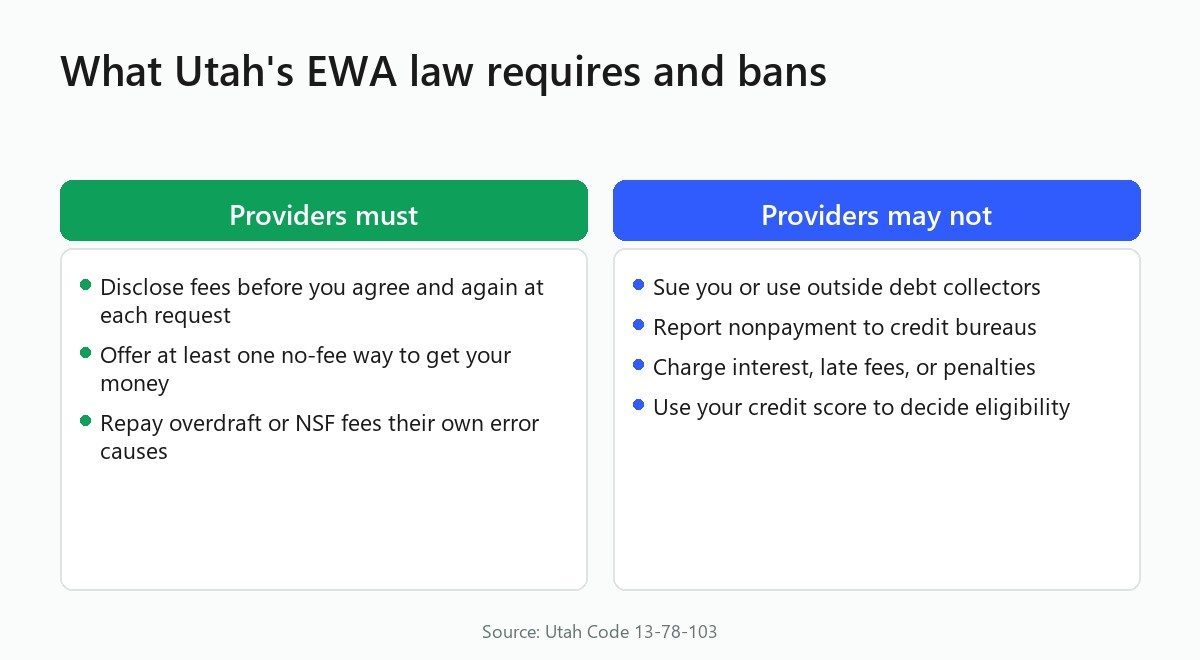
A registered provider may not compel repayment through any of the following (Utah Code 13-78-103(3)(a)):
The provider also can't use your credit report or credit score, as defined under the federal Fair Credit Reporting Act (15 U.S.C. Section 1681 et seq.), to decide whether you qualify for its service (Utah Code 13-78-103(3)(b)). No credit-card repayment is allowed either (Utah Code 13-78-103(3)(c)), and a provider can't condition your access to funds on paying a tip, gratuity, or donation, or mislead you about whether that payment is actually voluntary (Utah Code 13-78-103(3)(d)-(e)).
A provider still has one form of leverage. It can block you from requesting a new advance if you're carrying an unpaid balance from a previous transaction (Utah Code 13-78-103(5)).
That's the practical recourse a provider retains under Utah law. It can cut off your future access. It cannot chase you for the past-due amount the way a debt collector would.
Legally, the Act says no, but with a condition attached that's easy to miss if you only skim the summary. Utah Code 13-78-106 states that a provider offering EWA services is not offering a loan or other form of credit or debt, as long as the provider is not itself a creditor, a debt collector, or a lender under the Act's own definitions, and it states that fees, tips, and gratuities paid under the Act are not interest or finance charges. Registered providers that meet these terms are also exempted from Utah's Financial Institutions Act and its Collection Agencies Act (Utah Code 13-78-103(1)).
That exemption depends on registering and staying compliant. A provider only keeps the "not a loan" shelter if it registers with the Division and actually follows the rules in 13-78-103, the disclosure, no-cost-option, and non-recourse requirements covered above. A provider that skips registration or breaks those rules loses the protection, and its arrangement could be evaluated under ordinary lending law instead.
It's worth naming the pushback. The National Consumer Law Center argues that this style of state carve-out law effectively legislates the "not a loan" conclusion rather than applying it under existing consumer-credit standards.
The underlying concern is economic more than legal: a per-advance or per-subscription fee, critics say, functions a lot like a short-term credit charge no matter what label the statute puts on it. Utah's law settles the legal question for registered, compliant providers. It doesn't settle the economic debate, and you're entitled to weigh that fee against the cost of any other short-term option you have.
The Division's director can impose an administrative fine of up to $2,500 per violation, and a court can impose that same per-violation penalty, order the provider to give up any money it collected in violation of the Act, and award the Division its attorney fees, court costs, and investigative costs (Utah Code 13-78-104). If a provider then ignores the resulting administrative or court order, that carries its own separate civil penalty of up to $5,000 per violation.
Notice what's absent from that structure. The Act's enforcement mechanism runs through the Division of Consumer Protection, not a private-lawsuit provision written into Chapter 78 itself. If a provider wrongs you, your direct path under this statute is a complaint to the Division, which can then investigate, fine the provider, or refer the matter to court. That's a different posture than a law that hands you the right to sue a provider yourself, and it's worth knowing going in.
Utah is the seventh state to pass EWA-specific legislation, following Nevada, Missouri, Kansas, Wisconsin, South Carolina, and Arkansas. Our guide to Nevada's earned wage access law walks through how that earliest framework took shape, if you want the full picture. Missouri, Kansas, and South Carolina followed with similar registration-and-disclosure frameworks; our separate articles on Missouri's and Kansas's earned wage access laws cover those states in more depth.
Wisconsin also regulates EWA, but its rules differ from Utah's; our Wisconsin earned wage access law article covers that state's approach in detail. Connecticut stands apart from that group entirely; instead of a standalone EWA statute, it folded these products into its existing Small Loan Law with a capped fee, a structural difference worth knowing if you ever move states or use an app that operates across state lines. A worker moving between any of these states should treat each app's terms as state-specific, since protections don't automatically travel with you.
If you're still weighing whether an EWA advance is the right move at all, our comparison of earned wage access and payday loans lays the trade-offs out directly against a payday loan's cost structure. Our look at whether cash advance apps are safe to use is a useful next stop before you tap "confirm" on your next advance.
Utah's earned wage access law is the Earned Wage Access Services Act, codified as Utah Code Title 13, Chapter 78. It took effect May 7, 2025, requires EWA providers to register with the Division of Consumer Protection, and sets disclosure and non-recourse rules for how providers can operate (Utah Code 13-78-102, 13-78-103).
Yes. A person may not act as a provider in Utah without registering with the Division of Consumer Protection (Utah Code 13-78-102(1)). Providers already operating when the law took effect had until October 6, 2025 to apply, and that deadline has passed.
Legally, no, but only if the provider is registered and compliant. Utah Code 13-78-106 says EWA is not a loan as long as the provider is not a creditor, debt collector, or lender under the Act's own terms and follows its consumer-protection rules. A provider that skips registration loses that shelter.
No. Registered providers may not sue you, make collection calls, use third-party debt collectors, sell your debt, or report nonpayment to a consumer reporting agency (Utah Code 13-78-103(3)(a)). What a provider can do is block you from requesting another advance until you've paid off your existing balance (Utah Code 13-78-103(5)).
Utah's law doesn't cap fees for the paid option. It requires every provider to offer at least one no-fee way to receive funds and disclose all fees clearly before you agree to pay them (Utah Code 13-78-103(2)(e)). That's different from Connecticut, which brings EWA under its Small Loan Law with a capped per-transaction fee.
File a complaint with Utah's Division of Consumer Protection, which oversees earned wage access providers under Utah Code 13-78. The complaint process is on the Division's earned wage access program page at dcp.utah.gov. The Division can investigate, fine a provider up to $2,500 per violation, and refer the matter to court (Utah Code 13-78-104).

Louisiana's EWA Act (La. R.S. 9:3591) took effect August 2025. No licensing, no fee cap, disclosure and no-cost rules apply instead.
Read article
Arkansas passed an EWA law in 2025, but no agency licenses providers, and the state's usury cap may still apply. Here's what that means for you.
Read article
Maryland now licenses EWA and cash advance apps, caps fees, and bans tips. Here's what the law requires and what to check before you use one.
Read articleSee how the top earned wage access apps stack up on fees, limits, and speed. View the full ranking