October 16, 2026
Arkansas Earned Wage Access Law Explained (Act 347)
Arkansas passed an EWA law in 2025, but no agency licenses providers, and the state's usury cap may still apply. Here's what that means for you.
Read article


Louisiana earned wage access law is currently in force and has applied to every provider serving Louisiana workers since August 1, 2025, according to FastDemocracy's legislative tracker. The statute is the Louisiana Earned Wage Access Services Act, codified at Louisiana Revised Statutes 9:3591.1 through 9:3591.7 under House Bill 368 and Act No. 496 from the 2025 Regular Session, and it has governed EWA providers statewide since that date, according to Goodwin Procter's review of the law. If you're a shift worker in Baton Rouge or a gig driver in New Orleans checking whether the app on your phone is regulated at all, the answer is yes.
The law began as House Bill 368 in the 2025 Regular Session, sponsored by Representative Vincent J. St. Blanc, III, and enacted as Act 496. It became law without Governor Jeff Landry's signature, according to FastDemocracy's bill tracker.
That detail is a footnote more than a finding, but it tells you the bill did not draw a veto fight. What matters more for a worker deciding whether to trust an EWA app is what the statute actually does, and just as importantly, what it leaves alone.
Louisiana's Act sets a floor of consumer-facing rules that apply to any provider offering earned wage access to people working in the state. Providers must fully and clearly disclose all fees before a consumer enters an agreement, and they must inform consumers of their rights under the Act, according to Goodwin Procter's review of the law.
The single most consequential requirement, though, is the no-cost option. Providers must offer and clearly explain "at least one reasonable option for obtaining earned wage access at no cost," according to the same Goodwin Procter alert. The law leaves the price of a faster or premium transfer up to the provider. It requires only that a free path exist and be explained in plain terms.
Beyond disclosure and the free tier, compliant providers are barred from several practices that show up often in traditional small-dollar lending:
Goodwin Procter's alert lays out these restrictions in full. These aren't nothing. A provider that cannot check your credit, cannot charge late fees, cannot pursue you through a collections agency, and has to cover an overdraft it caused is operating under meaningful limits.
This is the part that separates Louisiana from states with a stricter regulatory posture, and it's the part a worker comparing apps needs to understand before assuming a law on the books means a price cap exists too.
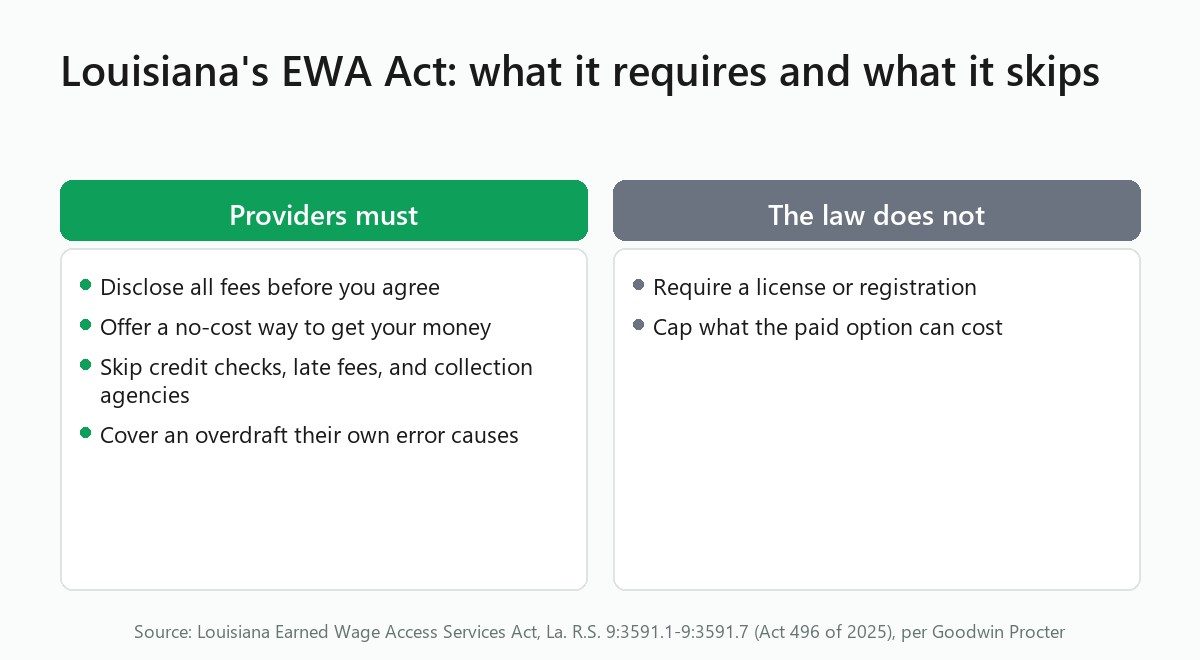
First, there is no licensing or registration requirement. A provider does not need to register with the Office of Financial Institutions (OFI) to operate in Louisiana, which puts the state in a different category from Nevada, California (through the DFPI), Missouri, and Kansas, all of which require some form of state registration for EWA providers, according to Goodwin Procter. Practically, that means no state agency is vetting a provider's business model or granting it a license before it can start serving Louisiana workers. Compliance with the Act's rules is largely self-directed, and enforcement happens after the fact.
Second, and this is the detail most worth sitting with, there is no fee cap. Louisiana's statute sets no dollar limit and no percentage ceiling on what a provider can charge for its paid tier. Goodwin Procter's review of the Act's full provisions covers the disclosure duty, the no-cost-option mandate, and the prohibited-practices list, but no fee ceiling of any kind appears among them; the paid tier's price is left entirely to the provider.
That absence is worth sitting with. When you're told Louisiana "regulates" earned wage access, know what kind of regulation that is. It amounts to disclosure and a mandatory free option, with no ceiling on what the paid version can cost.
No, at least not under this statute. The Act includes language stating that providers who comply with its requirements "are not deemed to be engaged in lending, money transmission, or debt collection," per Goodwin Procter's review of the Act. That's a direct statutory carve-out, and Louisiana isn't alone in taking this approach. Nevada and Missouri have built similar frameworks that define compliant EWA out of lending law rather than folding it in.
Connecticut went the other direction entirely, classifying EWA as a loan and applying real fee and interest caps as a result. The practical effect of Louisiana's carve-out is straightforward: because EWA isn't classified as lending here, the protections that attach specifically to loans, like APR disclosure requirements or usury caps, don't apply. That's simply the logical consequence of the lending label not applying, and it's a good reason to read the fee terms in an app's agreement rather than assume loan-style math is happening behind the scenes.
For the fuller picture of how EWA pricing compares to a payday loan's, and why the lending label matters for what you actually pay, see our earned wage access versus payday loans comparison.
The Louisiana Attorney General enforces the Act under the state's Unfair Trade Practices and Consumer Protection Law, according to Goodwin Procter.
OFI's role is narrower than the name of the office might suggest. Fee-charging providers must submit an annual report to OFI covering their revenue, transaction count, number of unique consumers served, total proceeds, and total fees and tips collected, with the first report due no later than March 1, 2027, per Goodwin Procter's summary of the reporting provisions. It then compiles that data into a public aggregate report, due by July 1 each year, assessing EWA's impact statewide.
The Louisiana Office of Financial Institutions' own website carries no EWA-specific licensing or guidance page, which lines up with the law's no-licensing design. The office's role is limited to collecting and publishing that annual data; it does not approve or supervise individual providers.
What does that mean if a provider treats you unfairly? Your recourse in Louisiana runs through consumer protection law and the Attorney General's office, a different path than you'd have in a state where an agency directly licenses and disciplines providers.
Connecticut is the clearest contrast. Connecticut classifies EWA as a form of lending and imposes real fee and interest caps as a condition of operating in the state, a fundamentally different regulatory philosophy than Louisiana's disclosure-and-carve-out approach. If you're weighing an app that operates in both states, the underlying legal treatment of your advance, and the ceiling on what it can cost you, really differs depending on where you're sitting. Our Connecticut earned wage access law guide walks through how that state's caps work in practice.
Missouri takes a different path on licensing than Louisiana does. Missouri requires EWA providers to register with the state, something Louisiana's law does not ask for. Both states share one thing: each defines compliant EWA out of lending law, the same carve-out Louisiana uses to say an advance isn't a loan.
Licensing is where the two states diverge, and it matters for how a provider gets held accountable before it ever serves its first Louisiana customer. Missouri's registration step gives a state regulator a chance to review a provider's model before it operates in the state; Louisiana's law skips that step entirely and relies on disclosure and after-the-fact enforcement instead. Our Missouri earned wage access law guide covers that state's specific registration rules.
The pattern across the country right now is mixed, and state legislatures are still working through it. Some states are choosing licensing and price limits. Others, including Louisiana, are choosing disclosure obligations and a mandatory free tier while leaving pricing to the market. A worker moving between states should not assume the rules travel with them, and a provider that operates nationally may follow noticeably different rules depending on which state you happen to be working in when you tap for an advance.
Here's what these rules mean if you're deciding whether, or how, to use an EWA app in Louisiana.
Look for the free-tier option every compliant provider is required to offer. Check the fee schedule or FAQ section for the standard, no-cost transfer option before assuming you have to pay for access to money you've already earned.
Understand that nothing in Louisiana's law stops a provider from charging what it wants for expedited transfers, since there's no fee cap here the way there is in Connecticut or Maryland. Compare fees across a few apps before settling on one, the same way you'd compare any recurring cost. Our earned wage access fees guide is a useful next stop for understanding what you're actually being charged for.
You do have a disclosure right. A provider is required to tell you the fees clearly before you agree to anything, so if a term feels buried or unclear, that's worth flagging or simply walking away from that provider.
Providers can't collect repayment by charging your credit card, and they can't send an unpaid advance to debt collection under Louisiana's compliant framework. A provider also can't screen you out based on your credit score in the first place. Those are enforceable limits on how a provider can treat you, even without a fee cap sitting alongside them.
If you're still weighing whether earned wage access fits your situation at all, our guide on whether EWA is right for you covers the broader decision beyond any one state's rules.
Since Louisiana leaves pricing to the provider, the burden of comparison shopping falls on you more than it would in a state with a hard fee cap. A few minutes spent reading an app's fee schedule before you set up an account can save you more than any single advance is worth. Consider working through these questions before you connect a bank account or a paycheck to any provider:
None of these questions require legal training to answer. They require reading the fee disclosure the law already requires the provider to give you, and treating that disclosure as the negotiating tool it's meant to be.
Yes. The Louisiana Earned Wage Access Services Act, codified at Louisiana Revised Statutes 9:3591.1 through 9:3591.7, took effect August 1, 2025, according to FastDemocracy's bill tracker, and has regulated EWA providers in the state since, according to Goodwin Procter's review of the law. The statute grew out of House Bill 368, passed in the 2025 Regular Session.
No. Louisiana's law sets no fee cap or interest-rate ceiling on the paid tier of an EWA product, per Goodwin Procter's review of the Act's provisions. The law instead requires a no-cost access option to exist alongside any paid one.
They do not. Louisiana's statute does not require EWA providers to register or obtain a license with the Office of Financial Institutions, unlike states such as Nevada, California, Missouri, and Kansas, according to Goodwin Procter. Oversight instead runs through disclosure rules and enforcement after the fact.
No, under this statute compliant EWA providers are not treated as engaging in lending, money transmission, or debt collection, according to Goodwin Procter. That means loan-specific protections, like APR disclosure or usury caps, don't apply to EWA products in Louisiana the way they would to a traditional loan.
The Louisiana Attorney General enforces the Act under the state's Unfair Trade Practices and Consumer Protection Law, according to Goodwin Procter. The Office of Financial Institutions collects annual data from fee-charging providers and publishes an aggregate public report, but it does not license or directly supervise individual providers.
Providers must fully and clearly disclose all fees before a consumer enters an agreement and must inform consumers of their rights under the Act, including the requirement that at least one no-cost option for accessing earned wages be available and clearly explained, according to Goodwin Procter.

Arkansas passed an EWA law in 2025, but no agency licenses providers, and the state's usury cap may still apply. Here's what that means for you.
Read article
Utah's Earned Wage Access Services Act regulates EWA apps under Utah Code 13-78. See what protections it gives you and what it doesn't.
Read article
Maryland now licenses EWA and cash advance apps, caps fees, and bans tips. Here's what the law requires and what to check before you use one.
Read articleSee how the top earned wage access apps stack up on fees, limits, and speed. View the full ranking