October 22, 2026
Louisiana Earned Wage Access Law: The Rules Now
Louisiana's EWA Act (La. R.S. 9:3591) took effect August 2025. No licensing, no fee cap, disclosure and no-cost rules apply instead.
Read article


Yes. Arkansas's earned wage access law is Act 347 of 2025 (House Bill 1517), the Earned Wage Access Services Act, codified at Arkansas Code Title 23, Chapter 52, Subchapter 2, Sections 23-52-201 through 23-52-204. Governor Sarah Huckabee Sanders signed the bill on March 20, 2025, and it has been in effect since later that year.
Earned wage access is a service that lets a worker draw a portion of wages already earned but not yet paid, typically for a flat fee, an optional tip, or no cost at all, ahead of the regular payday. Law firm Goodwin Law counts Arkansas as the sixth state to pass an earned wage access statute when it enacted Act 347, joining a small group of states that had already moved to regulate the product by name.
What the law leaves out matters just as much as what it covers. It sets disclosure and conduct rules for providers. It does not create a license, a registration system, or a state agency assigned to police the industry day to day. If you're an hourly or gig worker in Arkansas trying to decide whether a paycheck-advance app is safe to trust with your bank account, that gap is the first thing worth understanding before you read the fine print of any app's terms.
Section 23-52-203 of the Act lays out what a provider has to do to operate in Arkansas, and it reads more like a consumer-protection checklist than a licensing statute. A provider must:
The same section bars several practices outright. A provider cannot charge a late fee, a deferral fee, interest, or any penalty if you don't repay on time. It cannot pull your credit report or credit score to decide whether you qualify for an advance.
It also cannot take repayment through a credit or charge card, sue you over an unpaid advance, hand your account to a third-party debt collector, or sell your balance to a collection agency. It cannot split fee or tip revenue with your employer either. If a provider takes repayment out of your bank account and that withdrawal triggers an overdraft or NSF fee, Section 23-52-203 requires the provider to reimburse it.
Read together, those provisions describe what a decent earned wage access product should already look like: transparent about cost, easy to walk away from, and not structured to punish a rough week. How earned wage access compares to payday loans lays out that difference in full, and it's worth reading before you judge how much Act 347's protections are worth. Those protections are what a worker gets in Arkansas, and knowing them is the first line of defense before you tap "advance."
Act 347's Sections 23-52-201 through 23-52-204 contain definitions, the prohibited-practices list above, and an exemption for banks and credit unions. Nowhere in that text does the legislature create a license, set up a registration process, or hand enforcement authority to a named state agency.
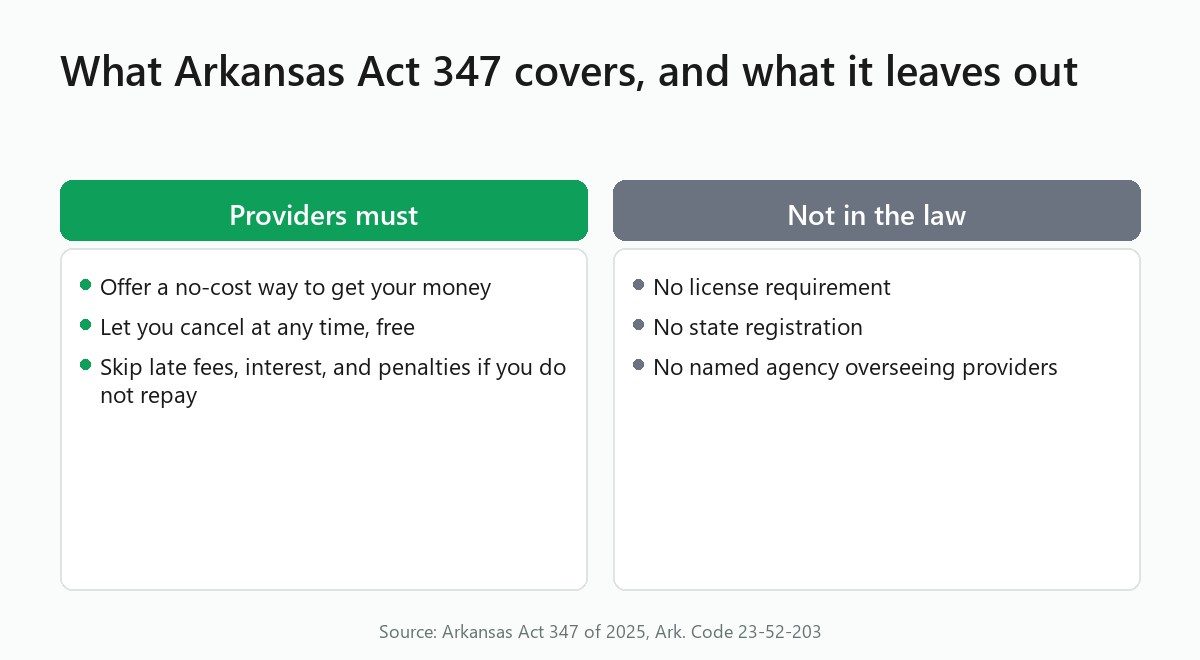
There is no Arkansas Securities Commissioner review built into the statute. No State Bank Department sign-off. No dedicated earned wage access enforcement unit at all, and no examination process a provider has to pass before opening its app to Arkansas customers. The statute's text and Hudson Cook's legal analysis confirm the same reading: a disclosure-and-conduct statute with no licensing component.
That puts Arkansas in the middle of a spread you'll see across other states' earned wage access rules. Texas has no earned wage access statute at all. Nevada sits at the other end, and Nevada's licensing model shows what a fuller regulatory structure looks like in practice: its law assigns direct oversight to the Financial Institutions Division, which reviews and licenses providers before they can operate there. Missouri lands in between, with a state registration requirement that's the middle-ground example worth knowing if you're comparing how different states handle this product.
Arkansas has real rules written into its code, but nobody checking whether a given app follows them day to day. Practically, this means there's no license number to look up before you download an app, and no Arkansas agency you can call to ask whether a company is allowed to operate in the state. The rules in Section 23-52-203 apply to any provider doing business here regardless.
Enforcing them, though, is a different question than the one a Nevada or Missouri worker gets to ask their state regulator. That absence doesn't make the rules optional for a provider doing business here, but it does mean compliance rests more on the provider's own choice to follow the statute than on a regulator checking its work day to day.
This is the part most coverage of Act 347 skips over, and it's where Arkansas's law gets more interesting, and more uncertain, than a standard state disclosure statute. Section 23-52-203(b) states that a provider "shall not be deemed to be engaging in lending, money transmission, or debt collection," but only if it complies with the requirements listed above.
That condition matters. It means the safe harbor only shields a provider following the rules, and only against those three legal categories, on the theory that an earned wage access advance is not a loan to begin with. The trouble is that Arkansas has an unusually broad constitutional usury ceiling, and the state's own Supreme Court has already thrown out a similarly structured carve-out once before.
Arkansas Constitution Amendment 89, Section 3, adopted by voters in 2010, caps the maximum lawful interest rate on "loans or contracts not described in Sections 1 and 2" at 17% per year. Amendment 89 replaced the older Amendment 60 language from 1982, so any current discussion of Arkansas's usury ceiling should cite Amendment 89, not Amendment 60, which no longer controls. Notice the wording of that cap: it reaches "loans or contracts," a phrase broader than just formal lending instruments.
Arkansas's Supreme Court has struck down a comparable "this isn't a loan" statute once before, under the usury provision in force at the time. The Arkansas Check-Cashers Act of 1999 tried to let payday-style advance products operate outside the state's usury cap by defining them as something other than loans. The Arkansas Supreme Court disagreed, and Courthouse News Service reported that the court ruled the Check-Cashers Act unconstitutional in litigation that ran from 2003 to 2008, with the case reaching its final resolution in November of that year.
Hudson Cook's legal analysis draws the direct connection between that precedent and Act 347, flagging the usury question in Arkansas as one worth watching given that history. The firm's published read states that Arkansas's usury cap "applies broadly to 'loans or contracts,'" wording that covers formal lending instruments and ordinary contracts alike. The firm's conclusion follows from that reading: Act 347's non-lending language "likely offers limited protection from Arkansas's constitutional usury limits."
Treat that for exactly what it is: one law firm's professional reading of how a future case might go, built on a real precedent involving a different statute. No Arkansas court has ruled on Act 347 itself, and no lawsuit challenging an earned wage access provider under the usury cap has been decided so far. The legal question remains open.
Hudson Cook's analysis adds one more piece of context worth knowing. Arkansas has no general licensing requirement for unsecured lenders in the first place, which the firm cites as part of why Act 347 changes less in Arkansas than similar laws changed in states that already licensed short-term credit products before their own earned wage access laws arrived.
None of the usury uncertainty above is something you need to resolve before using an app, and it isn't your job to litigate that question. What Act 347 actually gives you is real, and it stands on its own regardless of how the loan-versus-not-a-loan debate eventually plays out.
A no-cost option has to exist. Fees have to be disclosed before you agree. Cancellation has to be free. A provider that follows Section 23-52-203 cannot chase you with late fees, credit checks, or a debt collector if you don't repay on time.
Those protections apply the moment a provider does business in Arkansas, and they don't wait on a future court ruling to take effect.
What you don't get is a state agency backstop if a provider ignores those rules. There is no Arkansas earned wage access regulator to file a complaint with, and no license number to verify before you sign up. If you run into a problem with an app in Arkansas, the state's general consumer-protection channel is the Arkansas Attorney General's consumer complaint process. That channel handles consumer disputes broadly; it was not built for earned wage access specifically, and no Arkansas Attorney General guidance or enforcement action on this product category has surfaced as of this writing.
Given that gap, the practical move is to lean on Act 347's disclosure requirements yourself, since nobody else is checking on your behalf. A provider operating in good faith should be able to answer every item on this list without hesitation, and one that dodges any of them is telling you something. Before you use any earned wage access app in Arkansas, work through a short list.
That last point is also the fastest way to tell an earned wage access product from something that behaves like a payday loan wearing different branding. Before trusting any advance app with your bank account, run through the questions to ask before using a cash advance app. Arkansas's statute gives you a legal baseline for those questions. A provider that fails them is breaking a specific rule in Section 23-52-203, not just an industry norm.
Yes. Arkansas Act 347 of 2025, codified at Arkansas Code Section 23-52-201 and following, permits earned wage access providers to operate in the state as long as they follow the disclosure and conduct rules in Section 23-52-203, including offering a no-cost option, disclosing fees up front, and allowing free cancellation.
No. Act 347's text contains no licensing or registration requirement and names no state agency to oversee providers. That sets Arkansas apart from states like Nevada, where the Financial Institutions Division licenses providers directly, and Missouri, which requires state registration.
Under Section 23-52-203, a provider following Act 347 cannot charge you a late fee, a deferral fee, interest, or any other penalty for nonpayment. It also cannot pull your credit report to qualify you, sue you over an unpaid advance, or turn your account over to a debt collector.
That question has not been settled by an Arkansas court. Act 347 says a compliant provider is not "deemed to be engaging in lending," but law firm Hudson Cook has argued that protection may offer limited coverage given Arkansas's broad usury cap and a past ruling against a similarly structured carve-out. No lawsuit has tested that theory yet.
Arkansas Constitution Amendment 89, Section 3, caps interest on loans or contracts not otherwise addressed by the amendment at 17% per year. Whether that cap reaches earned wage access advances depends on how a court eventually treats them, and that has not happened yet.
The Arkansas Attorney General's office runs a general consumer complaint process that covers financial products broadly. It is not a channel built specifically for earned wage access, and no Arkansas Attorney General guidance or enforcement action targeting this product category has been identified as of this writing.

Louisiana's EWA Act (La. R.S. 9:3591) took effect August 2025. No licensing, no fee cap, disclosure and no-cost rules apply instead.
Read article
Utah's Earned Wage Access Services Act regulates EWA apps under Utah Code 13-78. See what protections it gives you and what it doesn't.
Read article
Maryland now licenses EWA and cash advance apps, caps fees, and bans tips. Here's what the law requires and what to check before you use one.
Read articleSee how the top earned wage access apps stack up on fees, limits, and speed. View the full ranking