October 21, 2026
Bonus Paycheck Calculator: Why Checks Look Smaller
See why your bonus paycheck looks smaller than expected, calculate the withholding by hand, and know what to do with what's left.
Read article


OASDI on your paycheck is the Social Security tax. It's 6.2% of your gross pay, your employer is required to withhold it, and you have no election to opt out. Federal law requires this deduction.
You pull up your stub, do the math on what you thought you'd earn, and the number staring back is smaller. Somewhere in the deductions column sits a line labeled OASDI, and it's taken a real bite. You didn't request it, you can't find it on the schedule you were quoted, and it looks almost like a mistake.
That gap between what you expected and what actually landed is exactly the moment most people go searching for answers. Maybe this is your first paycheck from a new job, or maybe you've been staring at this line for years without ever looking it up. Either way, the confusion is common, and the fix is quick.
This answer alone probably raises three more questions. What does the money actually fund? Why does it sit next to a separate Medicare line? And if you pick up gig shifts instead of W-2 hours, does any of this even apply to you?
None of those questions have complicated answers, but they do take a few real numbers to answer well, which is exactly what the rest of this breaks down.
OASDI is short for Old-Age, Survivors, and Disability Insurance. It's the formal name for what most people just call Social Security. The tax funds retirement benefits for people who've aged out of the workforce, survivor benefits for the families of workers who've died, and disability benefits for workers who can't work because of a qualifying condition.
Every paycheck you earn chips into that same pool, funding retirement, survivor, and disability benefits for people relying on the program today. That pool goes straight out to a retired neighbor collecting a monthly check, to a widow or widower raising kids on survivor benefits, to a former coworker who can no longer work because of a disability. It's a mandatory contribution to a system you're also enrolled in.
This is why the deduction never feels optional and, legally, isn't. Under the Federal Insurance Contributions Act (FICA), OASDI and Medicare withholding are both mandatory. The rates are fixed by statute; only the wage base changes each year, and neither your employer nor your state has any say in either one (IRS Topic 751).
It also explains why you can't adjust this the way you can adjust your federal income tax withholding. When you fill out a W-4 for a new job, you're setting your federal income tax withholding, which can go up or down depending on what you enter on the form. OASDI and Medicare don't work that way. They're flat statutory rates applied to each paycheck up to the limits above, and no form you fill out at onboarding changes them.
These are the numbers that apply to your check right now.
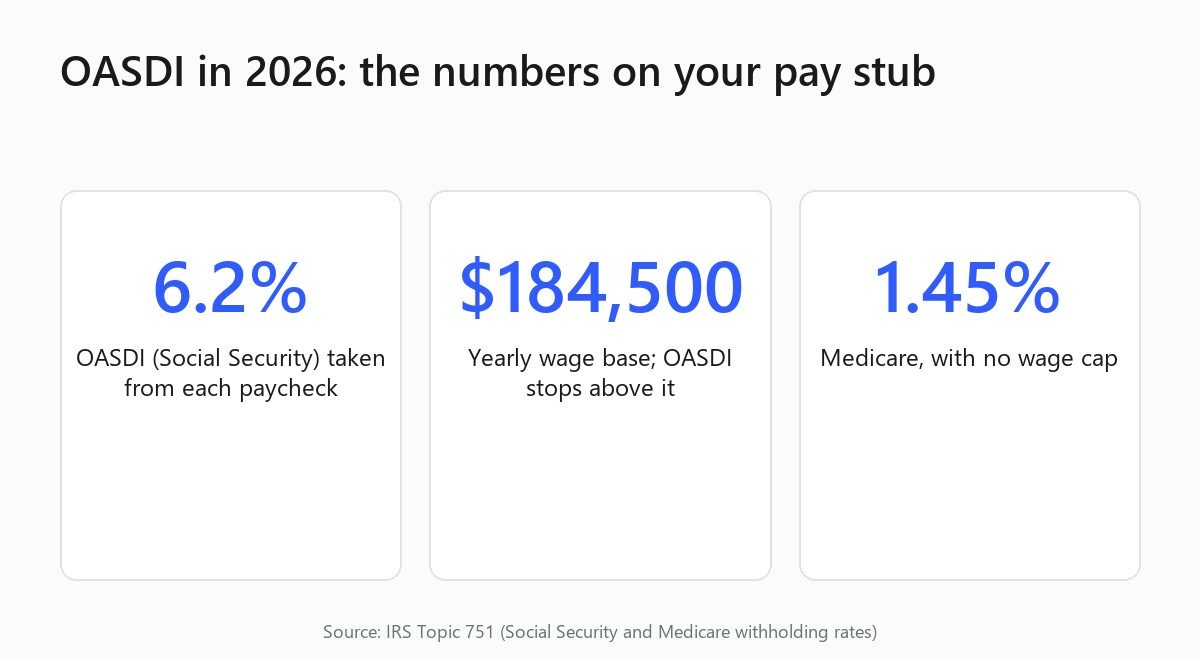
If you're reading this on an hourly or shift-based paycheck, that cap probably isn't touching your income this year, and that's fine. What matters for your budget is the 6.2% that comes out of every single check, no matter how small. Unless your pay is approaching $184,500 a year, this cap won't affect you, so this is one detail you can safely file away and stop worrying about.
Right below or beside your OASDI line, you'll usually see another deduction for Medicare. The two travel together because they're both part of FICA: OASDI funds Social Security, and Medicare funds hospital insurance. The IRS defines FICA as the combination of "the old-age, survivors, and disability insurance taxes, also known as Social Security taxes, and the hospital insurance taxes, also known as Medicare taxes" (IRS Topic 751).
The Medicare piece works a little differently than OASDI, and the difference matters. Medicare is withheld at 1.45% of all wages, matched by your employer, with no wage cap. Unlike OASDI, it never stops during the year, regardless of how much you earn (IRS Topic 751).
So while a high earner eventually sees OASDI drop off their stub once they cross $184,500, Medicare keeps coming out of every check, all year, no exceptions. Both lines are calculated the same simple way: a fixed percentage of that check's gross wages.
There is one Medicare wrinkle worth a quick mention, mostly so you can rule it out. An Additional Medicare Tax of 0.9% applies to wages above $200,000 for a single filer, $250,000 married filing jointly, or $125,000 married filing separately, with no employer match (IRS Topic 560). Unless your income is well into six figures, this doesn't touch your check, and you can move on. If you ever do cross $200,000 in wages from one employer, that employer starts withholding the extra 0.9% automatically, regardless of your filing status; any difference based on your actual filing status is settled when you file your return.
Numbers land better on your own math than on someone else's abstraction. Now for a realistic hourly stub, worked line by line.
Say you work 35 hours a week at $18.50 an hour, paid biweekly, so a paycheck covers 70 hours.
That $99.07 is money that leaves your check before you ever see it, on top of whatever federal and state income tax withholding takes as well. That money funds Social Security and Medicare, the programs the tax is named for.
It explains a big part of the gap between "gross pay" and "what actually hits my account," and it's the same gap most W-2 workers see, whether they earn $18.50 an hour or $85 an hour. Once you know the OASDI and Medicare lines are fixed and predictable, you can plan around them instead of being surprised by them every payday. Knowing that $99.07 is coming out of a $1,295.00 check, consistently, every period, means you can build your budget on the number that actually lands in your account rather than the one printed at the top of the stub.
Most people budget around the number that hits their account, which is the right instinct. The trouble starts when OASDI and Medicare deductions catch you off guard week after week because your plan was built around gross pay instead of net pay, which is one way people end up living paycheck to paycheck when payroll deductions are eating the check without being accounted for.
The one concrete step worth taking this week: pull your last stub and circle the OASDI and Medicare lines, then add them together. That combined percentage, roughly 7.65% for most W-2 workers, is money you should treat as already spent before it ever reaches you.
This matters even more if your hours vary week to week, which brings irregular income and inconsistent withholding into the picture for hourly and shift workers. A slow week with fewer hours means a smaller gross paycheck, and OASDI and Medicare scale down right along with it since both are calculated as a flat percentage of whatever you actually earned that period. There's no minimum withholding and no flat fee tacked on regardless of hours, so a short week of shifts never costs you more proportionally, in tax withheld, than a full one does.
If you're trying to stretch what's left after taxes, knowing exactly where that 7.65% goes, and knowing it isn't negotiable, at least takes the guesswork out of one part of your paycheck. You can spend your energy managing the parts of your budget you actually control: rent timing, grocery spending, and how far you make each check go until the next one lands.
If you've moved between W-2 shifts and gig-app payouts as one of the many gig workers who owe self-employment tax instead of payroll withholding, you've probably noticed something odd: the gig money looks bigger when it lands. There's no OASDI or Medicare line taken out of a rideshare or delivery payout the way there is on a paycheck.
That's because platforms that pay you as a 1099 contractor don't withhold FICA taxes at all. Instead, you owe self-employment tax, and you pay it yourself, usually at tax time or through quarterly estimated payments rather than per-payout. Because it isn't withheld automatically the way payroll taxes are, it's on you to set that money aside as it comes in rather than owing all of it in one lump sum later.
Self-employment tax totals 15.3%: 12.4% for OASDI, subject to the same $184,500 2026 wage base cap that applies to W-2 workers, plus 2.9% for Medicare, which is uncapped, applied to 92.35% of your net self-employment earnings. You can deduct half of the self-employment tax, the employer-equivalent portion, when figuring your adjusted gross income (IRS Topic 554).
On a realistic gig week, that math looks like this. Say you net $650 after platform fees and expenses.
That $91.84 doesn't come out of the $650 automatically. You owe it later, at filing or through quarterly estimated payments, which is exactly why gig income can feel deceptively whole in the moment and then hit hard at tax time.
This is the piece that trips up a lot of people moving between W-2 and 1099 work. A W-2 paycheck already has its OASDI and Medicare taken out before it reaches you, so the number in your account is the number you can spend. A gig payout hasn't had anything taken out yet, so part of it is already spoken for even though it's sitting in your balance.
If you're stacking gig shifts alongside W-2 hours, it's worth setting aside a portion of each gig payout for this bill rather than treating the full amount as spendable. Moving roughly 15% to a separate account the day it lands covers the self-employment tax piece; income tax on top of that is separate and needs its own set-aside. It's a small habit, but it's the difference between a tax bill you planned for and one that ambushes you in April.
OASDI usually isn't the only abbreviation confusing you. Two others show up often enough to mention briefly: FIT, which generally stands for federal income tax withholding, and YTD, which means year-to-date totals for a given category.
Both are common payroll conventions rather than terms defined by statute the way OASDI and Medicare are, so treat them as general labels your payroll system uses, not fixed legal terms. If your stub uses different shorthand, your HR or payroll contact can confirm exactly what each line means.
The YTD figures are useful once you understand OASDI, since you can compare your year-to-date withholding against your year-to-date gross pay.
No. OASDI is a mandatory payroll tax under federal law, withheld at 6.2% of gross wages, with no employee election to skip or reduce it. This applies whether you're full-time or working part-time shifts (IRS Topic 751).
Only once your year-to-date wages cross the annual wage base, which is $184,500 for 2026. After that point, OASDI withholding stops for the rest of the calendar year and resumes the following January (IRS Topic 751). Most hourly and shift workers won't reach this cap.
Yes. OASDI, or Old-Age, Survivors, and Disability Insurance, is the official name for the Social Security tax and program. The abbreviation is what shows up on your stub; "Social Security tax" is what most people call it in conversation (IRS Topic 751).
OASDI is withheld at 6.2% and stops once you cross the annual wage base. Medicare is withheld at 1.45% and never stops, no matter how much you earn in a year. Both are part of FICA, and both appear as separate lines on most stubs (IRS Topic 751).

See why your bonus paycheck looks smaller than expected, calculate the withholding by hand, and know what to do with what's left.
Read article
The 30% rent rule explained for hourly pay, with real wage math and what to do if you're already over it.
Read article
From 25% to two-thirds, the paycheck to paycheck number depends on the survey. See what each one measures, by income band, and your first move.
Read articleSee how the top earned wage access apps stack up on fees, limits, and speed. View the full ranking