October 21, 2026
Bonus Paycheck Calculator: Why Checks Look Smaller
See why your bonus paycheck looks smaller than expected, calculate the withholding by hand, and know what to do with what's left.
Read article


You find a place. The rent sounds fine, maybe even like a deal, until the first paycheck lands and taxes have already taken their cut. Now the number on the lease and the number in your bank account are two different conversations, and only one of them pays the bills. If you're trying to figure out how much of your paycheck should go to rent, the honest answer starts with a question landlords rarely ask out loud: are we talking about your gross pay, or the money you actually get to spend?
That gap matters more the lower your hourly wage sits. A salaried worker looking at one steady number a month has an easier time applying a rule of thumb. Someone paid by the hour is doing this math against a paycheck that shrinks the moment payroll withholds for FICA and income tax, and at low wages what's left over after rent is often just too few dollars to cover the rest of the month. The "30% rule" comes from a specific place, it stops working cleanly at low wages, and a landlord's income screen requires real dollars that don't always match it, as the worked numbers below show.
The U.S. Department of Housing and Urban Development defines a household as "cost burdened" once it spends more than 30% of income on housing, and "severely cost burdened" past 50%. HUD's own research notes that cost-burdened households "may have difficulty affording necessities such as food, clothing, transportation, and medical care," according to HUD USER's research on rental affordability.
Most budgeting articles skip the part that matters most: that 30% figure was never a financial formula derived from spending data. According to HUD USER, it's a HUD-era policy choice from the 1970s and 1980s, built to set how much rent a household in federally assisted housing, like public housing or a Housing Choice Voucher, would be required to contribute. Over time it got borrowed as a general affordability guideline for market-rate renters too, but nothing about the number is a law you're bound by if you rent an apartment on the open market.
Treat it as a useful yardstick for planning. No one can enforce it as a ceiling on your rent, and staying under it is no promise the month will feel comfortable.
If you rent through a voucher program, the 30% figure determines what you're required to pay. If you're renting at market rate, it's a planning target you're choosing to use, and you're free to weigh it against your own numbers rather than treat it as gospel.
A percentage feels the same at every income level on paper. In real life, it isn't. Thirty percent of a low paycheck leaves very few actual dollars for food, transportation, and medical costs once rent is paid, because those costs don't shrink just because your wage does.
A $20-an-hour worker who sticks to the 30% rule still has roughly $1,700 a month left after rent for everything else. A $7.25-an-hour worker following the same rule has roughly $779 left, before groceries, gas, a phone bill, or a car repair even enter the picture. That's the mechanical reason the rule bends at the bottom of the wage scale: it was built as a ceiling, and it was never a promise that whatever's left over would cover a life.
This isn't a small or shrinking problem. The U.S. Census Bureau found that more than 21 million renter households, 49.7% of all 42.5 million renter households, spent over 30% of their income on housing costs in 2023, and the median renter's housing-cost-to-income ratio was 31%, according to the U.S. Census Bureau.
Harvard's Joint Center for Housing Studies has also reported that renter cost burdens have continued to worsen and now sit at record highs, according to the Joint Center for Housing Studies. If you're already over the 30% line, you're standing next to roughly half of all renter households in the country. You're not failing some test everyone else is passing.
This is where a lot of rent math quietly goes wrong. Landlords tend to use your gross pay, the number before taxes, when they talk about "30% of income." But you don't pay rent out of gross pay. You pay it out of what actually lands in your account after federal and state withholding and FICA come out.
That means there are really two different 30% ceilings sitting on top of each other: 30% of gross, and 30% of take-home. The take-home number is always the stricter one. The lower your wage, the more you should plan against the take-home number alone, because a smaller paycheck has less room to absorb the difference.
Federal minimum wage has sat at $7.25 an hour since July 24, 2009, the longest stretch without an increase since the Fair Labor Standards Act became law in 1938, according to the U.S. Department of Labor, Wage and Hour Division. At that wage, the gap between what a lease says and what a pay stub shows is the widest it gets on the hourly pay scale.
There's a second test standing between you and a lease, and it's separate from the 30% rule entirely. Many landlords and property managers screen applicants by requiring gross monthly income of at least three times the monthly rent, sometimes 2.5 times in certain markets, according to TurboTenant's tenant-screening guidance. This is common industry practice, not a federal law, and some states or cities limit how landlords can apply it, so it's worth checking your local tenant-screening rules before assuming a 3x standard applies everywhere you look.
Fair housing law also means income screening can't be used as a workaround to discriminate against protected income sources, like housing vouchers, in places that protect them. Screening rules aside, the practical twist is this: the 3x-rent screen and the 30% rule are answering two different questions, and they don't always agree.
Do the algebra and something becomes obvious. If a landlord requires income of at least 3 times the rent, that's mathematically the same as saying rent can be at most one-third, or about 33%, of gross income. That's a little looser than the 30%-of-gross guideline. A landlord can approve a rent that clears their screen without it actually being affordable by the 30% standard, especially once you measure against take-home pay instead of gross.
Numbers make this concrete. The same math, run at four hourly wages: federal minimum wage, and three common step-ups from there. Gross monthly pay assumes a standard 40-hour week, 52 weeks a year, divided by 12 months.
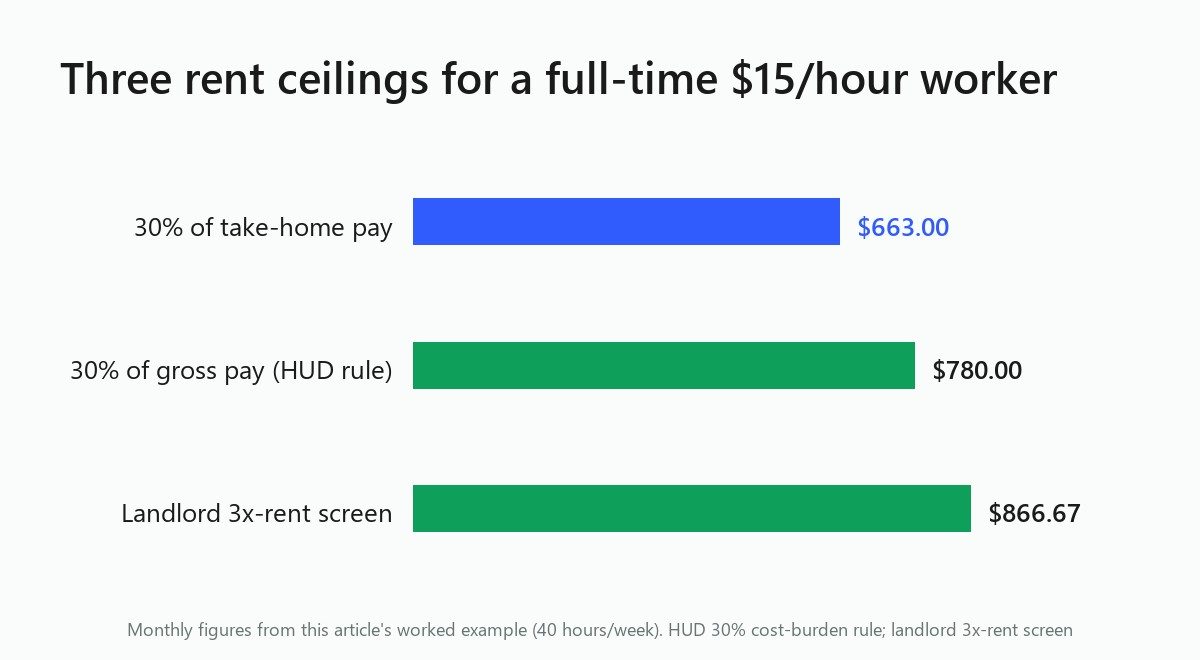
Take-home pay here is an estimate that assumes a flat withholding rate per wage tier: FICA is fixed at 7.65% for everyone, and the income-tax portion rises with wage because minimum-wage earners typically owe little to no federal income tax after the standard deduction, while higher hourly wages move into taxable brackets. Your actual take-home will vary by state income tax, filing status, dependents, and any benefits withheld from your check, so treat these as planning estimates, not a substitute for looking at your own pay stub.
Look closely at the $7.25 row and the pattern that opened this article shows up in real numbers. The landlord's 3x-rent screen allows rent up to about $418.89, a little looser than the $377.00 that 30% of gross would allow. That gap gets wider once you measure against what actually lands in the bank: 30% of take-home pay is only $346.84, which is $72.05 less than the landlord's ceiling. Passing the landlord's income screen never guarantees the rent is affordable.
If your current or target rent already eats more than 30% of your paycheck, you're not doing anything wrong by existing in that gap, and you're not alone in it. What actually moves the needle, in order of how fast each one tends to help:
If your hours change week to week, the math above gets harder to pin down, since your gross pay isn't the same every month. Our guide on managing irregular income covers how to budget rent against a paycheck that moves. If the paycheck-to-paycheck cycle itself is the deeper issue, a step-by-step plan to stop living paycheck to paycheck is the place to start, then come back to stretch what's left of your paycheck once rent is settled.
A common guideline is 30% of income, but the safer number is 30% of your take-home pay, not your gross paycheck. At lower hourly wages, using gross pay can make a rent look affordable when it actually leaves very little for food, transportation, and other essentials.
The same 30% guideline applies, but calculate it against take-home pay after taxes, since that's the money you actually have to spend. Multiply your hourly wage by 40 hours and 52 weeks, divide by 12 for a monthly gross figure, then apply your own withholding rate before taking 30% of what's left.
No. It's a HUD affordability standard that legally applies to federally assisted housing, like public housing or Housing Choice Vouchers. For market-rate renters, it's a budgeting guideline only, not a cap or a right enforceable against a landlord, so nothing stops a market-rate lease from asking for more than 30% of your income.
Requiring gross monthly income of at least 3 times the rent (sometimes 2.5 times) is a common tenant-screening practice landlords use to gauge whether an applicant can afford the rent. It's an industry convention, not a federal law, and some states limit how it applies, so check local rules.
You're not unusual: the U.S. Census Bureau found nearly half of all U.S. renter households spent more than 30% of income on housing in 2023. Start by recalculating against your take-home pay, then look at adding a roommate, picking up targeted extra hours, negotiating with your landlord, or looking at rent tiers two or three steps lower.

See why your bonus paycheck looks smaller than expected, calculate the withholding by hand, and know what to do with what's left.
Read article
OASDI is the Social Security tax on your check: 6.2% of gross pay, no way around it. See the 2026 rate, wage base, and a real stub example.
Read article
From 25% to two-thirds, the paycheck to paycheck number depends on the survey. See what each one measures, by income band, and your first move.
Read articleSee how the top earned wage access apps stack up on fees, limits, and speed. View the full ranking