October 15, 2026
How Much of Your Paycheck Should Go to Rent?
The 30% rent rule explained for hourly pay, with real wage math and what to do if you're already over it.
Read article


Your boss says "$5,000 bonus" in the meeting. Your direct deposit says something closer to $3,500. That gap feels like a mistake. Some people assume payroll shorted them, or worse, that someone skimmed off the top on purpose.
Neither is true. The IRS treats your bonus differently than your regular paycheck, and once you see the math laid out, the number on your bank statement stops feeling random. This is the same math a bonus paycheck calculator runs behind the scenes, and you can run it yourself with a pen and a few minutes, no app required.
Understanding this once means you'll never have to wonder about it again, whether the bonus is $500 or $15,000. The percentages stay the same. Only the dollar figures change.
The IRS calls a bonus a "supplemental wage." So are overtime pay, a commission check, and severance. Supplemental wages have their own withholding rules under IRS Publication 15 (Circular E). Employers get to pick between two withholding methods for supplemental wages, and which one they use is up to them, not you.
That's the part most people never hear explained. It's also why a $5,000 bonus can land two different ways at two different jobs, depending entirely on which method payroll runs it through. Let's walk through both.
Under Publication 15, employers can withhold a flat 22% federal rate on your bonus, separate from whatever your regular paycheck withholding looks like. That 22% applies to the first $1 million in supplemental wages an employer pays you in a calendar year. Anything above that million gets withheld at 37% instead. That threshold will not apply to nearly anyone reading this article.
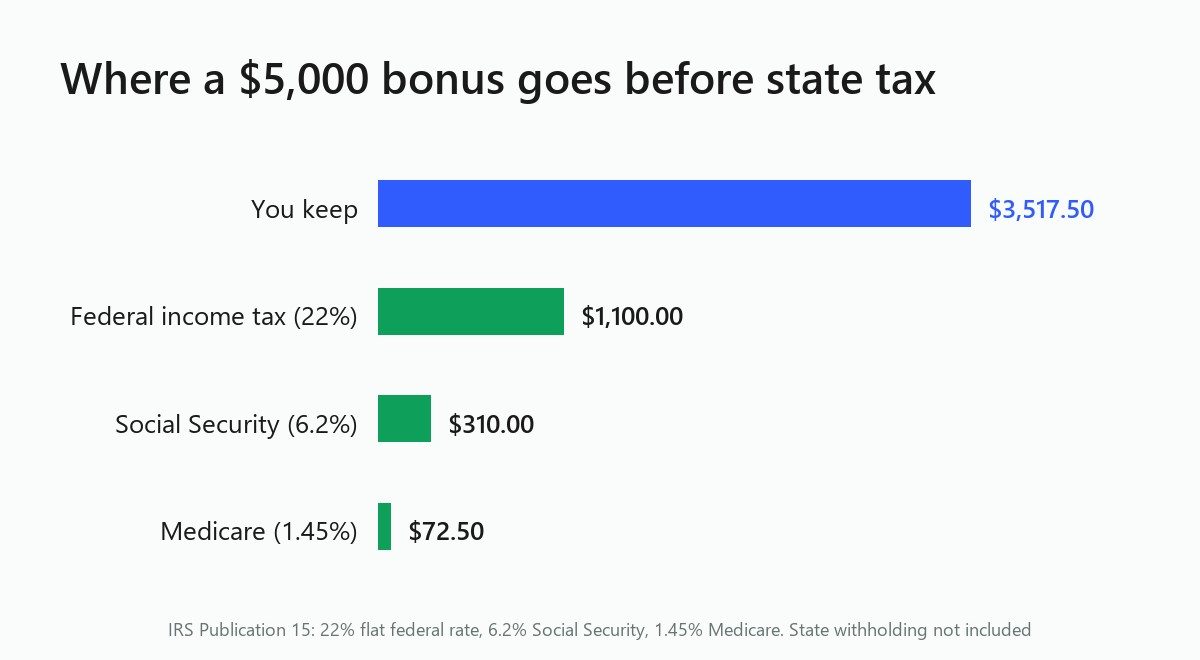
Here's exactly how to calculate bonus paycheck withholding by hand, using a $5,000 gross bonus paid on its own, separate from a regular paycheck:
Already, close to 30% of a $5,000 bonus is gone before it hits your account, and that's before your state takes its own cut. That's the gap people notice and assume is a mistake. It's actually just federal income tax withholding plus FICA, working exactly the way Publication 15 says it should.
The aggregate method applies when a bonus is paid with, or combined into, a regular paycheck instead of issued as a separate check. Here, your employer adds the bonus to your normal paycheck amount for that pay period. Federal income tax then gets withheld on the combined total as though it were one large regular paycheck, using the wage-bracket and percentage-method tables in IRS Publication 15-T (2026), Federal Income Tax Withholding Methods, rather than the flat 22% rate.
Employers pick whichever method fits their payroll setup, not whichever one benefits you personally. That choice happens on the employer side, well before your bonus ever gets calculated.
What that means in practice: the aggregate method can withhold more than the flat method, or less, and which way it goes depends on your normal pay level and how you filled out your W-4. Someone with a modest regular paycheck who suddenly has a bonus stacked on top might get pushed into a higher withholding bracket for that one pay period than the flat method would have applied, even though their actual yearly tax situation hasn't changed at all.
Someone else, depending on their regular pay and filing status, might see less withheld than the flat 22% would have taken. There's no single number to hand you here, because the outcome depends entirely on your own paycheck and household situation.
If you want to know which method your employer used on a particular bonus, compare the federal withholding line on your pay stub against 22% of the bonus amount (the FAQ below walks through that comparison), or ask payroll directly. Neither method changes what you actually owe the government for the year. They only change how much gets held back right now, in this one paycheck, which is the piece that matters most when you're counting on that money to cover bills this week.
Whichever federal income tax withholding method applies, Social Security and Medicare get taken out the same way every time. Social Security withholding is 6.2% of your bonus, and Medicare is 1.45%, for a combined 7.65% that many people forget when they're doing quick mental math on what a bonus will actually net them.
Social Security withholding does have a ceiling. Once your total wages for the year cross an annual wage base set by the Social Security Administration, Social Security withholding stops for the rest of that year. Medicare works differently. It applies to every dollar you earn, bonus or otherwise, with no cap at all, ever.
There's one more piece worth knowing about, even though it won't apply to most people reading this. The IRS requires employers to withhold an extra 0.9% Additional Medicare Tax once wages from that employer pass $200,000 in a calendar year, and that $200,000 withholding trigger applies no matter your filing status. What you actually owe in Additional Medicare Tax gets worked out at filing, using a threshold of $200,000 for single filers, $250,000 for married couples filing jointly, or $125,000 for married filing separately, per the IRS guidance on the Additional Medicare Tax.
A large enough bonus can occasionally push someone's year-to-date wages from one employer over that $200,000 trigger, even when their full-year tax picture doesn't call for the extra tax at all. For most people living paycheck to paycheck, this is a genuine edge case, worth knowing about but not worth losing sleep over.
Everything above covers federal income tax and FICA. State withholding on a bonus is a separate line item, and it genuinely varies from state to state. Some states apply their own flat supplemental rate, similar in spirit to the federal 22%, while others require the aggregate method instead, folding the bonus into your regular pay for state withholding purposes.
States like Texas, Florida, and Washington have no state income tax at all, which means no state withholding on your bonus whatsoever. Where you live changes this line of the math more than almost anything else on this page.
There's no responsible way to hand you one state number that applies everywhere, because it depends entirely on where you live and work. Check the state withholding line on your bonus pay stub, or look up your state's department of revenue for the exact supplemental-wage rate that applies where you are.
This is the part that trips up the most people, and it's worth sitting with for a second. The 22% flat rate, the FICA percentages, and whatever your state takes are all forms of withholding. Withholding is a prepayment toward your total tax bill for the year, calculated as a shortcut at the moment your bonus is paid.
When you file your return, your bonus gets added to your total income for the year and taxed at your real marginal rate, whatever that turns out to be once every paycheck, deduction, and credit is accounted for. If your actual rate on that income lands lower than 22%, some of what was withheld comes back to you as part of your refund. If your actual rate lands higher, you'll owe the difference when you file, and in some cases a penalty on top if you underpaid by enough throughout the year.
Any online bonus paycheck calculator is estimating this same withholding figure. None of them can predict your final tax outcome, because that depends on your whole year, not one bonus check. IRS Publication 15 itself describes 22% as a withholding rate, and that framing, a rate meant to approximate your liability rather than settle it, is the whole reason bonuses so often feel like they came up short at the moment they land.
Once the number lands in your account, the real question shifts. It stops being about why the check is smaller and starts being about what to do with it now that you know exactly what you're working with.
None of this requires the whole bonus to go to any one place. Splitting it, a little to savings, a little to debt, a little to breathing room, tends to work better than an all-or-nothing plan, because it matches how real budgets actually function.
If you're trying to break the paycheck-to-paycheck cycle for good, a bonus is one of the few chances all year to make real progress without cutting anything from your regular budget. This is also a good moment to budget an irregular windfall the same careful way you'd want to budget any irregular income. If your paychecks move around a lot in general throughout the year, it's worth learning how to manage income that arrives unevenly so surprises like this one stop feeling disruptive every time they show up.
Your bonus isn't taxed at a higher rate. Your employer withholds at a flat 22% federal rate, or uses the aggregate method, because the IRS classifies bonuses as supplemental wages under IRS Publication 15. That 22% figure describes withholding at the moment of payment. Your actual tax rate on that income gets settled when you file.
Multiply your gross bonus by 22% for federal withholding, 6.2% for Social Security, and 1.45% for Medicare, then subtract all three amounts from the gross figure. A $5,000 bonus nets $3,517.50 before any state withholding, which varies depending on where you live.
No. A bonus paycheck calculator shows withholding only, meaning the flat 22% federal rate (or the aggregate-method amount), plus 6.2% Social Security and 1.45% Medicare. Your actual tax liability on that bonus gets determined when you file your return, based on your full year's income, deductions, credits, and marginal tax rate.
It depends on your actual marginal tax rate once you file. If your real rate on that income is lower than the 22% withheld, the difference typically comes back as part of your refund. If your rate is higher, you'll owe the difference at filing, since withholding is only a prepayment toward your total tax bill.
State withholding on bonuses varies by state. Some apply their own flat supplemental rate, some use the aggregate method, and states with no income tax, like Texas, Florida, and Washington, withhold nothing at the state level. Check your pay stub or your state's department of revenue for the exact figure that applies where you live.
Pull up your bonus pay stub and compare the federal line against 22% of the gross bonus, then check Social Security against 6.2% and Medicare against 1.45%. A match means your employer used the flat method. If it doesn't match, ask payroll which method they used on that bonus.

The 30% rent rule explained for hourly pay, with real wage math and what to do if you're already over it.
Read article
OASDI is the Social Security tax on your check: 6.2% of gross pay, no way around it. See the 2026 rate, wage base, and a real stub example.
Read article
From 25% to two-thirds, the paycheck to paycheck number depends on the survey. See what each one measures, by income band, and your first move.
Read articleSee how the top earned wage access apps stack up on fees, limits, and speed. View the full ranking